When alignment measurements are repeated, the target needs to return to the same position each time.
That sounds simple, but small changes in target location or orientation can create measurable differences in the results.
According to Hamar Laser trainer Ron Sullivan, developing a consistent target setup routine can make the difference between approximately .005 in. and .0005 in. of repeatability.
The good news is that the techniques are simple.
Mark the Target Position
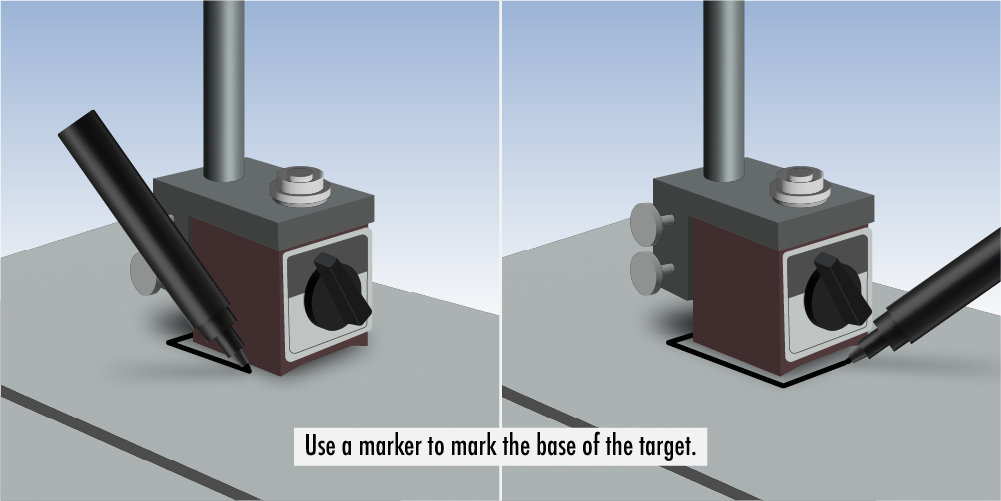
When a magnetic target base is removed and repositioned during a measurement, do not rely on visual estimation to return it to the same place.
Instead, trace an outline around the magnetic base on the measurement surface.
The outline creates a simple physical reference that makes it much easier to return the target to the same location for every measurement.
There are no special fixtures or measuring tools required.
A simple mark provides a repeatable setup reference.
Make Sure the Target Is Tight
Position is only part of the setup.
The target must also be tightly connected to the mounting post.
If the target can rotate or shift independently of the base, the measurement reference changes.
That can produce a reading difference even though neither the machine nor the marked base location has moved.
Before recording data, make sure the target, post and base are securely connected.
Understand the Target’s Field of Vision
The A-1519 target has a Target Angle Acceptance Range of ±10 degrees.
This is also referred to as its Field of Vision.
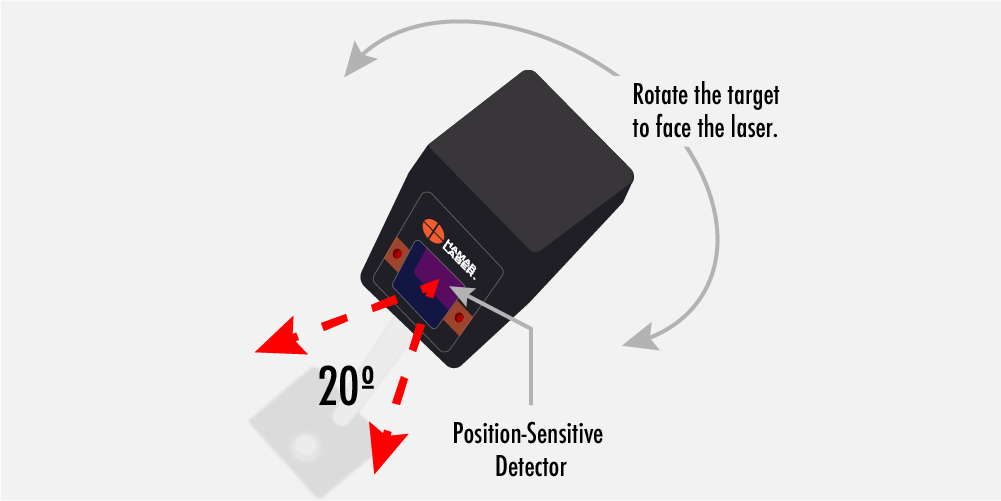
That means the target can receive the laser beam while positioned within a total angular range of approximately 20 degrees.
However, simply being within the target’s allowable range does not mean target orientation should be ignored.
For the most consistent measurements, the target should be pointed back toward the laser.
Why Target Angle Matters
The actual detector surface is recessed inside the target case.
As the target rotates away from the laser, the relationship between the incoming beam, the target opening and the recessed detector changes.
This makes target orientation part of the measurement setup.
For repeatable readings, rotate the target so that the face is directed toward the laser before recording data.
That should become a normal part of the measurement routine, particularly when the target is moved from one position to another.
Avoid Beam Clipping
Proper target orientation also helps prevent beam clipping.
Beam clipping occurs when part of the laser beam extends beyond the edge of the target detector.
Instead of the entire beam being measured normally, only part of the beam falls on the detector surface.
That can produce significant measurement errors.
The problem may not always be obvious simply by looking at the displayed number.
Rotating and aiming the target back toward the laser reduces the likelihood of clipping and keeps the beam correctly positioned on the detector.
You Do Not Need Special Tools
The target does not need to be perfectly aligned using a precision angular instrument.
For normal setup, the naked eye is sufficient.
Simply orient the target so that it is visibly facing the laser.
When learning the procedure, Ron recommends looking at the setup from both directions.
View the target from the laser side.
Then view the laser from the target side.
Doing this repeatedly helps develop a visual sense for correct target orientation.
Over time, that becomes muscle memory.
Build the Technique into Your Routine
Reliable alignment depends on repeatable measurement technique.
Before recording a measurement:
- Return the magnetic base to the marked position.
- Make sure the base is fully seated.
- Tighten the target to the mounting post.
- Rotate the target toward the laser.
- Verify that the beam is properly hitting the detector.
- Record the measurement.
None of these steps takes much time.
Together, however, they remove several variables that can affect repeatability.
Accurate Equipment Still Requires Good Technique
Modern electronic targets are capable of extremely precise measurements.
But the instrument cannot compensate for inconsistent setup procedures.
Marking the target position, securing the mounting hardware and correctly orienting the target are simple practices that help ensure the measurement reflects the actual alignment condition rather than changes in the setup.
That is why these techniques are emphasized during Hamar Laser training.
Learning how the equipment works is important.
Learning how to use it consistently is just as important.
Hamar Laser offers alignment training at customer facilities as well as at our own facility.
Training covers system setup, measurement procedures, alignment techniques and practical applications so users can develop reliable, repeatable measurement routines.
